October 08, 2026

Chargeback Rights When the Seller Says No

The laptop died with the fan still spinning: black screen, charger light on. The retailer's reply ran to one line, take it up with the manufacturer. That refusal feels final. It isn't. The card you paid with may owe you the money when the shop won't, and your chargeback rights are older and tougher than any returns policy.
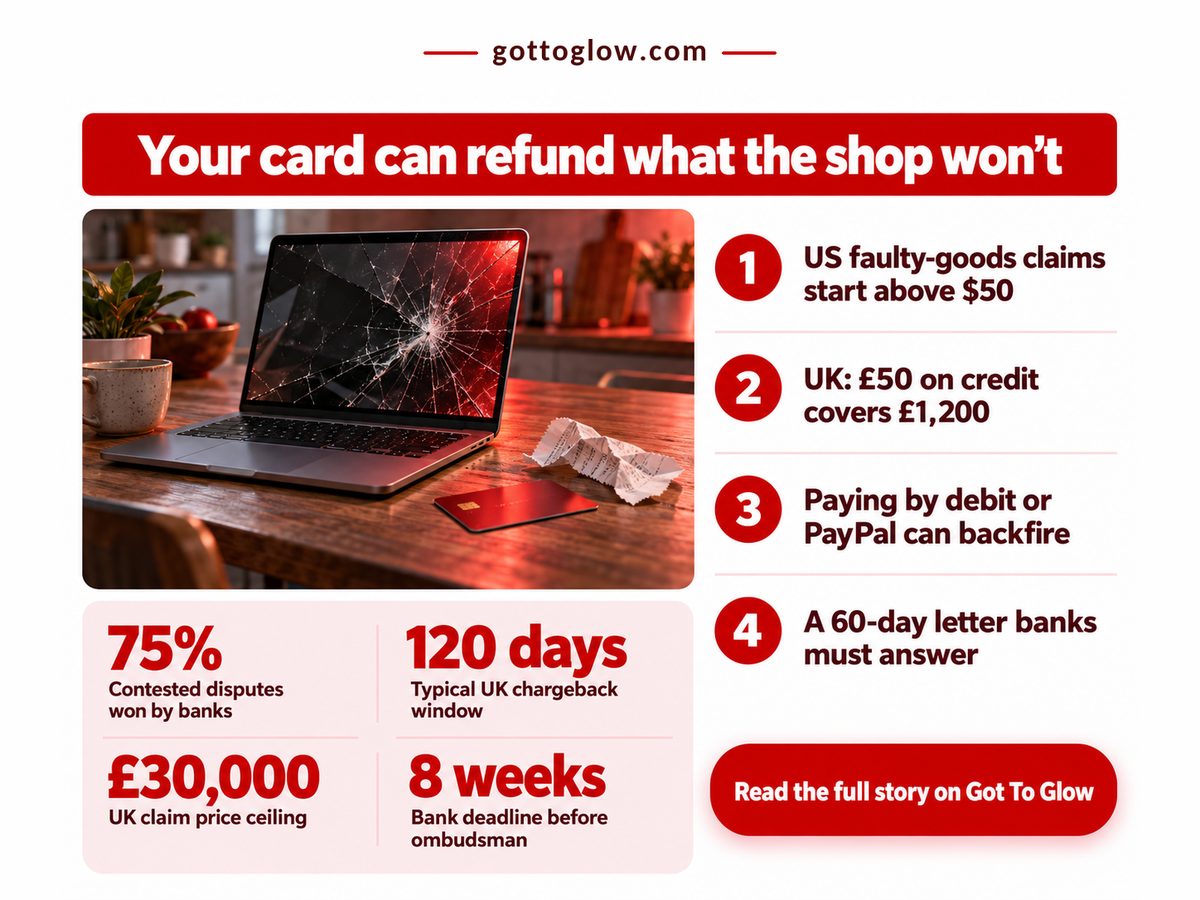
Infographic on chargeback rights: broken laptop, credit card, receipt and US-UK claim figures

My rule with a dead gadget: settle the money first, the machine second.

Key Takeaways: yes, if a credit card paid for the faulty gadget, the card company can be made to refund it after the seller refuses, if you act in time and keep proof.

  • US: the Fair Credit Billing Act lets you withhold payment for a faulty item, within price and distance limits.
  • UK: Section 75 makes the lender jointly liable, even if only a deposit went on the card.
  • Debit gets you a chargeback at best, at the bank's discretion.

Can I do a chargeback if the seller refuses a refund?

Yes, a refusal from the seller is usually the trigger for a card claim rather than the end of it, because US and UK law both let the card company stand in for a shop that won't pay.

In the US the route is the Fair Credit Billing Act. Its quality-claim section, 15 USC 1666i, lets you hold back the disputed amount on a credit card after a good-faith attempt to settle with the seller. The catch is price and distance, and both bite on a gadget ordered online from another state, unless the store issued the card. The FTC's guidance (as of 2024) is plain that debit cards get fraud protection, not faulty-goods rights. So anything costly goes on credit.

That is the payment-side sequel to who pays when a device fails after the maker's warranty and what bricked smart-device owners can claim from maker versus seller. Those settle who owes you. This is how you collect.

Britain goes further. Under Section 75, paying any part of the price by credit card, even a deposit, makes the lender jointly liable for all of it, says the Financial Ombudsman Service. A £50 deposit on a £1,200 laptop puts the full £1,200 on the card company. By my arithmetic that is £24 of protection per pound charged, and almost nobody uses it on purpose.

Four numbers decide whether a claim is worth starting: the FTC's US letter deadline, the ombudsman's UK ceiling, and two figures from Mastercard's 2025 State of Chargebacks survey of issuers and merchants, as summarised by Chargeback Gurus in June 2025.

US Dispute Letter Deadline

60 days

Miss it, lose the right

UK Section 75 Ceiling

£30,000

Covers any laptop or phone

Card Disputes in 2025

261 million

Banks triage before reading

Disputes Suspected as Abuse

13% to 21%

Why proof beats a story

The letter deadline is where people lose. It belongs to the billing-error route for goods not delivered as agreed, and its clock starts at the first statement showing the charge, not when the laptop died. Keep a dated copy; the issuer must then answer within fixed limits.

"

Banks sort millions of disputes, plenty of them dishonest. Dated photos and a written refusal lift yours out of that pile.

Chargeback rights in the US and UK, side by side

The UK protects a credit-card buyer more fully than the US does, because Section 75 has no distance test and covers part-payments, while the US quality claim carries price and location limits that many online purchases trip.

Read the left column first: rows run from qualifying to where you're exposed. US rows rest on 15 USC 1666i and FTC guidance; UK rows on the Financial Ombudsman Service.

Dimension US vs UK What it means for you
๐Ÿ’ฐ Price floor US Purchase over $50
UK Cash price over £100
⚠️ Cheap accessories rely on chargeback
๐ŸŒ Where bought US Home state or within 100 miles
UK No distance test
❌ Out-of-state online buys can miss out
⏱ Time limits US Reply in 30, resolve in 90 days
UK Chargeback about 120 days
⚠️ Act early, the clocks never pause
๐Ÿ”’ Debit card US Fraud cover only
UK Chargeback, no Section 75
❌ You can only ask, not claim
⚖️ Leverage US Withhold the disputed sum
UK Ombudsman after 8 weeks
✅ Free pressure, no lawyer needed
๐Ÿ Best suited for US Credit buys near home
UK Any credit buy, even part-paid
๐Ÿ Put costly kit on a credit card

In Britain, a credit card turns almost any gadget above the floor into a legal claim. In America, it depends on where the seller sits, unless a store card strips those limits away.

75%. issuer wins. Card issuer wins. Merchant wins, 20%. Other outcomes, 5%.

When a seller fights your dispute, the issuer usually comes out ahead, so a refusal is no reason to drop a documented claim. Source: Mastercard's 2025 survey via Chargeback Gurus; the other slice is our remainder.

How long do I have to file a chargeback, and what sinks a claim?

Deadlines run from different dates: UK chargebacks count from delivery of the faulty item, US dispute letters from the first statement showing the charge, and neither from the day the device broke.

The chargeback is weaker than it looks. In the UK it is card-scheme practice, not law, and the ombudsman says your bank doesn't have to raise one. So I'd skip the usual advice to just call your bank: ask for a Section 75 claim by name, and keep chargeback as the fallback.

Does Section 75 cover purchases made through PayPal?

Often not cleanly. Section 75 needs a direct link between you, the lender and the seller, and the ombudsman says that link "isn't always straightforward" when a wallet sits in between. Chargeback is then your likelier route, and pay-later plans open a similar gap, covered in our guide to Buy Now Pay Later refunds on financed devices.

If the bank says no, complain formally. Once its deadline in the table passes, or it sends a final response, the ombudsman can order a refund plus interest, free. Lawyer Monthly's November 2025 guide notes a six-month limit from that final letter.

Watch for:

  • A goodwill offer framed as final. Refuse it in writing if it falls short.
  • Returning the device before photographing the fault.
  • Seller emails that stall while your deadlines expire.

Before you file, check your own purchase

  • Some or all of the price went on a credit card.
  • The seller took payment directly, not through a wallet.
  • You hold a written refusal and dated photos of the fault.
  • In the US, the seller is local or issued the card.

Settle the money, then the machine. This week, send your card issuer a dated written dispute with the refusal and photos attached, naming Section 75 if you're in the UK. As for the laptop: replace it, don't repair it. A device that fails early and a seller that won't back it have told you what they're worth.
October 01, 2026

Bricked Smart Device? Who Owes You a Refund

The Wemo Mini on the hall shelf still clicks when you press its button. Ask Alexa to turn it on and nothing happens: on 31 January 2026 Belkin shut the Wemo cloud and app, per its Wemo support page, killing remote access and voice control. That is a bricked smart device in 2026. It powers on. It just can't do its job.

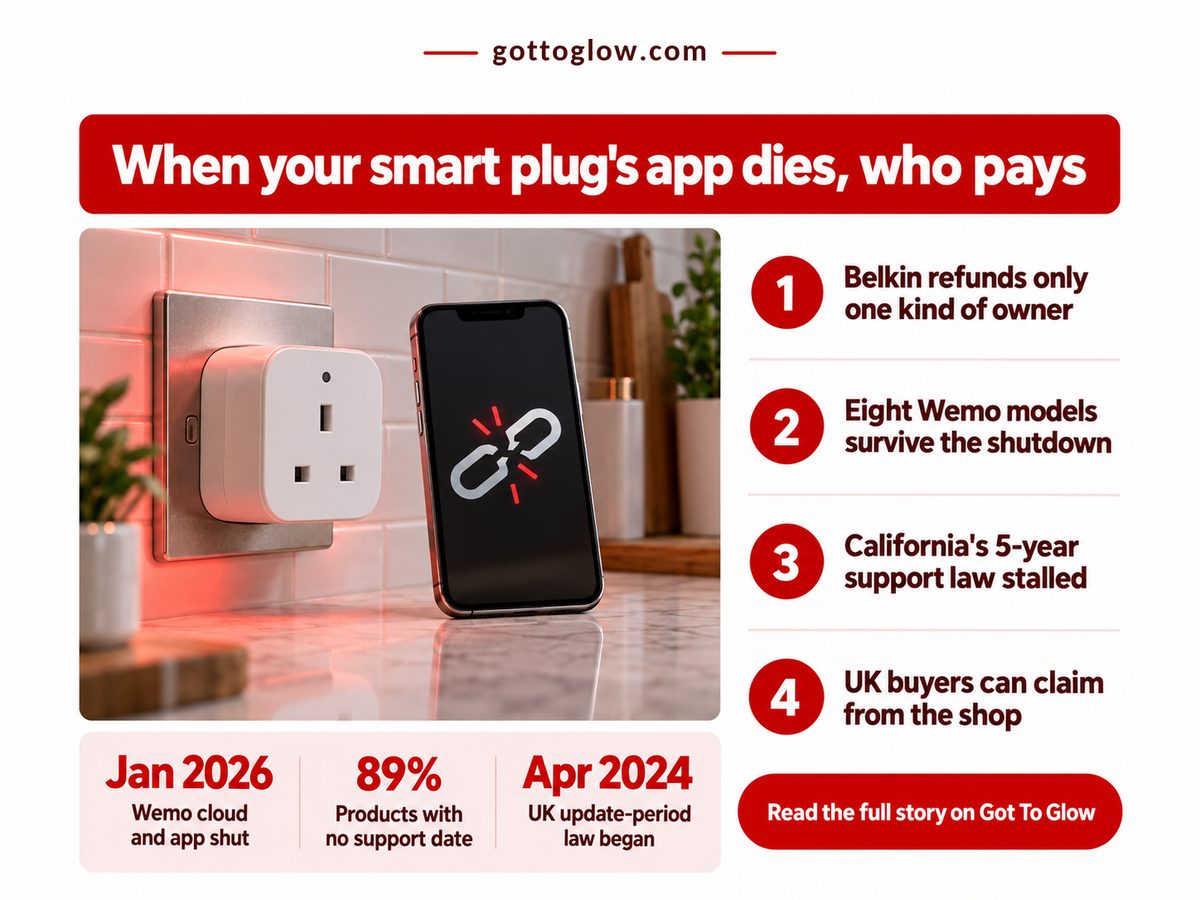
Infographic on a bricked smart device: unlit smart plug, phone app and refund rights

Keep, repair or replace? The answer depends less on Belkin than on where you bought it, and when.

TL;DR: Belkin refunds only in-warranty owners; past that, UK and EU law points at the shop and US law points almost nowhere.

  • Wemo kit paired to Apple Home before the shutdown, and the Thread models, still work locally: keep them.
  • UK and EU buyers claim against the retailer, not the maker, and that claim can outlast the maker's warranty.
  • No US state law yet requires a disclosed support period.
  • Check the model number and the receipt date before you bin anything.

Who pays for a bricked smart device after the warranty ends?

If the maker's warranty has run out, Belkin owes you nothing, so any money has to come from statute: in the UK and EU that means the retailer, and in the US it usually means nobody at all.

Belkin's terms are plain: refunds only for products still under warranty on or after 31 January 2026, with proof of purchase. Past that, look elsewhere; it is the same split that decides who pays for a device failure in month 14.

Outside the US, the claim was never really against Belkin. The UK Consumer Rights Act 2015 (sections 9, 10 and 24) requires goods of satisfactory quality, durability included, and that duty sits with the shop. Article 7(3) of the EU Sale of Goods Directive 2019/771 goes further: the seller must supply the updates a buyer could reasonably expect, and retailers must now spell that out in the EU legal guarantee notice and its new label.

The US is thinner, and the stock lemon-law advice is out of date here. California's SB 898 would have required a disclosed minimum support period of at least five years, but the CalMatters Digital Democracy bill record shows it held in committee on 13 August 2026. No state law yet gives a US buyer that right.

Four numbers set your leverage, drawn from Belkin's Wemo page, the FTC staff review PIRG summarised in November 2024 (as of 2024) and the EU Cyber Resilience Act timetable.

EU Support-Period Duty Begins

Dec 2027

Today's kit sits outside it

Belkin Refund Past Warranty

$0

Statute is your only route

Smart Products FTC Staff Checked

184

Wide enough to include yours

Gave No Support End Date

89%

You couldn't check before buying

That disclosure gap is the one US owners can use. The FTC said silence on support periods may breach the Magnuson-Moss Warranty Act and the FTC Act, so a missing end date is grounds for a free deception complaint.

"

Nearly nine in ten smart products never told buyers when the software would stop. That silence, not the hardware, is what turns a working plug into a paperweight.

Smart home end of support: US, UK and EU rights compared

The UK and EU give a buyer a claim against the retailer that can outlast the maker's warranty, while the US offers only the warranty itself and a possible deception complaint to the FTC.

Read the table by your receipt, not your passport: who pays first, then what you can claim, then the rules behind it.

Dimension US vs UK vs EU What it means for you
๐Ÿ’ฐ Who pays you US Maker, in warranty only
UK The shop that sold it
EU The seller, not the maker
⚠️ Outside the US, skip the maker
⏱ Claim window US The maker's warranty term
UK 6 years (5 in Scotland)
EU 2 years minimum
✅ Can outlast the maker's own cover
๐Ÿงพ Bought after US Inside warranty only
UK 31 Jan 2020
EU 31 Jan 2024
✅ Your receipt date settles it
๐Ÿ›  Updates owed US None by law
UK Durable goods, CRA s.9
EU Reasonable period, art 7(3)
⚠️ Rests on what a buyer could expect
⚖️ End date shown US Not required; SB 898 held
UK Required, PSTI, Apr 2024
EU Coming: 5-year floor, CRA
⚠️ Check before buying, not after
๐Ÿ Best route US Warranty claim to Belkin
UK Price cut from the shop
EU Seller remedy, with receipt
๐Ÿ Claim from whoever took your money

The purchase cut-offs in the third row are our own arithmetic: each country's claim window counted back from the shutdown date. A US owner past warranty has no row that helps.

Do Wemo devices still work after 31 January 2026?

Some do: Wemo plugs and switches paired to Apple Home before the shutdown keep working locally, and the Thread models are unaffected, but everything else on the Wemo line-up lost its smart functions.

5 models. Apple Home, paired by 31 Jan. 3 models. Thread versions, unaffected. 10 types. Lose app, voice and remote control. 8 to keep. Our sum of the first two groups.

If your Wemo sits in either of the first two groups, keep it and leave its pairing alone; anything in the third is a replace, however healthy it looks. Counts come from Belkin's Wemo support page (2026), and the keep total is our own sum.

Survivors include the Mini Smart Plug, the Video Doorbell and the WLS0503 switch. Insight, Link and the Crock-Pot are replacements.

Where a refund claim against the shop falls apart

A retailer claim can fail for ordinary reasons: no proof of purchase, a device that was never paired locally before the cutoff, or a shop arguing that a cloud service was never part of what it sold you.

That last argument is the real grey area. No UK court has ruled on whether switching off an app makes a plug unsatisfactory, or none I can find. My view: for a device sold as smart, with the app on the box, a shop will struggle to call the app optional.

A plug on a dead app also gets no patches, the exposure covered in how to protect your smart home from cyber threats. The UK product security regime, per its gov.uk policy paper, makes makers publish a minimum security update period, so you see the end date before paying. It awards no refund, though.

  • Find the receipt first; Belkin and the shop will both ask for it.
  • Don't factory-reset an Apple Home Wemo; Belkin's list covers only devices set up before the shutdown.
  • A private second-hand sale gives you no statutory claim against anyone.

Before you decide, tick these

Your model number appears on Belkin's Apple Home or Thread list.

It was added to Apple Home before the cloud went dark.

Your receipt date falls after the cut-off for your country.

You bought it from a shop, not from a private seller.

So: keep, repair or replace? Keep anything on the Apple Home or Thread lists. Repair is off the table: nothing a screwdriver can reach is broken. Replace the rest, but first, if you're in the UK or EU and your receipt clears the cut-off, write to the shop this week asking for a price reduction under the Consumer Rights Act or EU directive, receipt attached.