October 30, 2026
Section 75 Refund: Is Your Gadget Over £100?
Say a £300 pair of headphones dies in month fourteen. The shop points at its twelve-month guarantee, the maker says the same, and most people stop. That is where a section 75 refund becomes the claim nobody makes. It needs two checks, not a fresh receipt: the price of the one item, and the payment line on your statement.
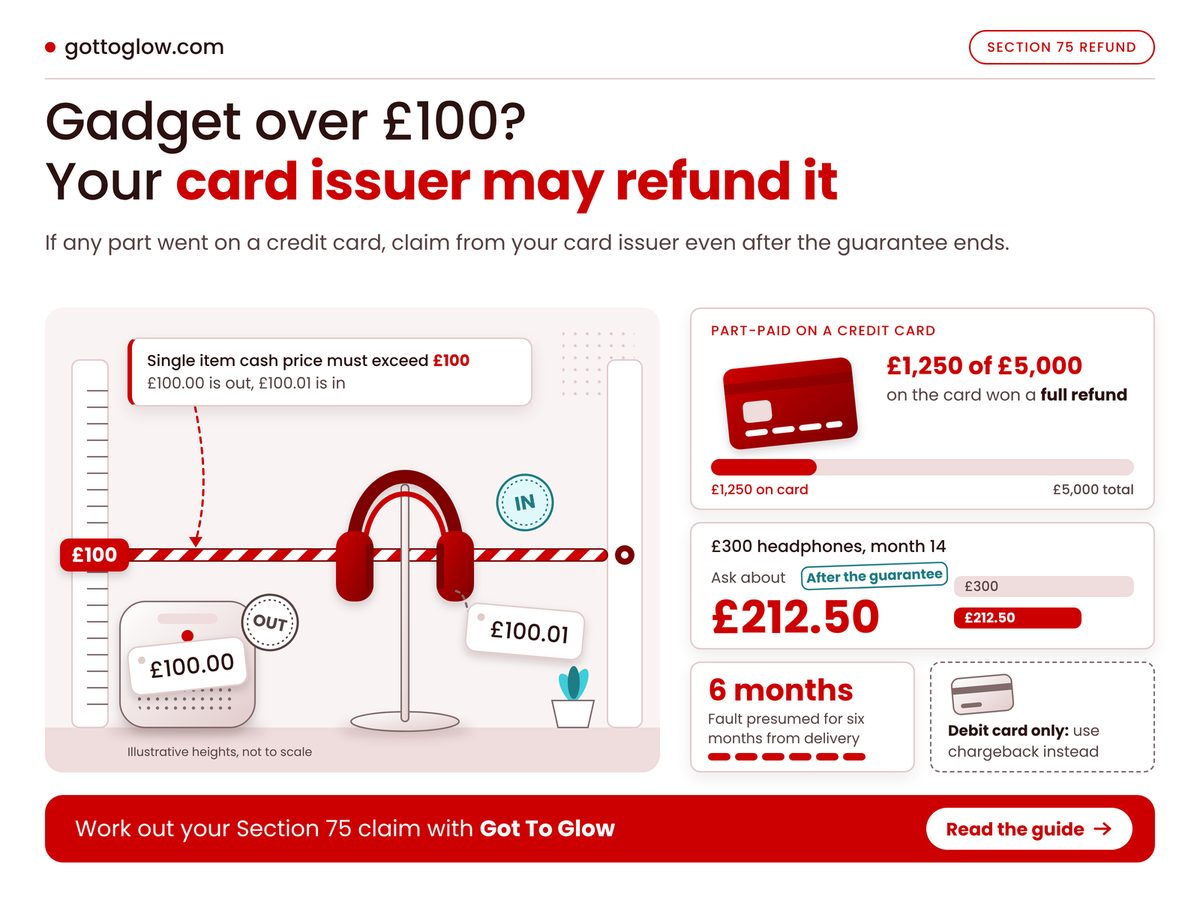
Yes: if one gadget cost over £100 and any of it went on a credit card, your card issuer is liable alongside the shop, even after the guarantee ends.
- £100.00 is out and £100.01 is in; each item's own price counts, never the basket.
- Wholly debit-card or bank-transfer payments fall outside it; use chargeback instead.
- Past month six, expect a refund reduced for use and bring evidence the fault started early.
Does a Section 75 refund cover a gadget over £100?
Yes, Section 75 of the Consumer Credit Act 1974 covers a single gadget with a cash price over £100 and up to £30,000 when any part went on credit, because the card issuer shares the seller's liability. Under section 75(1), as in force to 25 October 2026, you hold a “like claim” against the issuer for the seller's misrepresentation or breach of contract, and the two are jointly and severally liable.
The shop's guarantee is a separate promise, and its expiry proves little. The Financial Ombudsman Service October 2024 myths page upheld a complaint about a sofa that developed faults about 18 months after purchase, even though the retailer had gone into administration. Satisfactory quality, not guarantee length, decided it; our piece on who pays at month 14 covers the retailer's side.
Four numbers decide most claims: the price floor in Section 75(3)(b), the six-month presumption in Consumer Rights Act 2015 section 19(14), and the card share from the ombudsman's October 2024 holiday case.
Lowest Price That Qualifies
£100.01
One penny over the line
Fault Presumed Window
6 months
Counted from delivery day
Card Share That Still Won
25%
Derived: £1,250 of £5,000
Price Test Applies To
1 item
Never the basket total
The card share is the quiet one. The ombudsman tested the cash price of the holiday, not what the card carried, and ordered the money back in full with interest, so a small deposit on the card keeps the whole purchase inside the rule. Debit-card buyers are on a different route, set out in our guide to chargeback rights when the seller says no.
My stance: Section 75 gives you a route to the money, not a depreciation table. Past month six, expect a negotiation, not a formula.
Real buyers stall at the first refusal. In June 2025 a Mumsnet poster said a card issuer declined a cracked styling tool on the ground that it “became faulty after use”, then refunded in full after one call the next day. One thread is an anecdote, not data (I would not stake a claim on it), but a first refusal can be an opening position. Common advice says exhaust the retailer first. For a card purchase over £100 I would write to the issuer in parallel, since the statute already makes it liable.
Does the Section 75 £100 limit apply per item?
The £100 limit applies to each single item's cash price, never to a basket total or to the amount you put on the card, so a gadget bought alone is tested alone. The ombudsman rejected a claim on four £45 tickets plus £10 parking and a £19 booking fee: no single item cleared £100, so the £209 basket did not count. A £60 charger and £90 earbuds bought apart total £150 yet neither qualifies, while a £150 bundle sold as one item can; that comparison is my derivation, not a ruling. Find your row.
| If your case is | Your move | What decides it |
|---|---|---|
| £90 earbuds | Ask the shop, or try chargeback | Needs a cash price over £100 |
| £120 of £900 | Claim the whole £900 | Card share does not cap the claim |
| Debit card only | Use chargeback, not Section 75 | Wholly debit or transfer is outside |
| Add-on card | Ask the issuer before relying | Main cardholder must be the buyer |
| Over £100, credit | Claim from the card issuer | Issuer is liable alongside the shop |
Two rows decide most gadget claims: the receipt price and the payment line on your statement. Both take two minutes to check.
Worked example: a £300 pair of headphones, £100 of it on a credit card and the rest on debit, fails in month 14. Assume a four-year life, or 48 months; that is my guess, not a statutory figure. The item clears the single-item test and the card share does not cap the claim, so the ceiling is the full £300. Remaining life is 48 minus 14, so 34 of 48 months, or 70.8%, and 70.8% of £300 is £212.50 as an opening ask on these assumptions.
Which clock is running on your gadget decides how firm your claim sounds. Day 30 is the Consumer Rights Act section 22(3) reject window and month 6 comes from sections 19(14) and 24(10); months 14 and 24 follow from the worked example.
Why do Section 75 claims get stuck?
Claims stall mainly when the issuer says the fault arrived after purchase, or when the person claiming was not the main cardholder who made the purchase. For the first, ask the issuer to look again, then complain to the Financial Ombudsman Service, which is free. For the second, the ombudsman's dress case is blunt: a secondary cardholder's claim failed because the primary cardholder had no part in the purchase.
Time cuts the other way. Section 19(14) of the Consumer Rights Act 2015 presumes a fault was there on delivery if it appears within six months, and section 24(10) bars a deduction for use if you reject within those months, motor vehicles and some specified goods excepted. After month six the presumption stops helping and section 24(8) lets the seller deduct for use. Section 23 also requires a repair or replacement “within a reasonable time”, so a repair offer is not a refusal. Refurbished kit carries its own terms, set out in our comparison of refurbished phone warranties.
- Declined by phone: ask for the decision in writing, then request a second look.
- Retailer-only claim: the card issuer needs its own claim, not the shop's reply.
Check these before you write to the issuer
- ☐ Your card statement shows a credit card or loan line for this purchase, even a small one.
- ☐ The card is in your name as the main cardholder, not an add-on card.
- ☐ You can find the order date, so you know which side of month six you are on.
The decision is whether to claim from your card issuer or stop at the shop's refusal. With one item over £100 and any part on a credit card, claim from the issuer this week and ask for the full cash price, settling for a used-adjusted figure after month six; with debit only or £100 or less, ask for a repair and keep the gadget rather than replace it. This fails if the whole price went on debit, so read the statement line first; the ombudsman guidance frames the claim. Write today: send the issuer your order date and a note of the fault.
How we checked this
We read section 75 of the Consumer Credit Act 1974 (in force to 25 October 2026), the ombudsman myths page (24 October 2024) and Consumer Rights Act 2015 section 19, 22 and 24 (checked 31 October 2026). The worked example assumes £300, £100 on credit, failure at month 14 and a four-year life. No product was tested hands-on for this article. Last verified: 31 October 2026. Edited by G Ragu, reviewed after publication. Spotted something out of date? Tell us and we will correct it.
No comments
Post a Comment