October 08, 2026
Chargeback Rights When the Seller Says No
The laptop died with the fan still spinning: black screen, charger light on. The retailer's reply ran to one line, take it up with the manufacturer. That refusal feels final. It isn't. The card you paid with may owe you the money when the shop won't, and your chargeback rights are older and tougher than any returns policy.
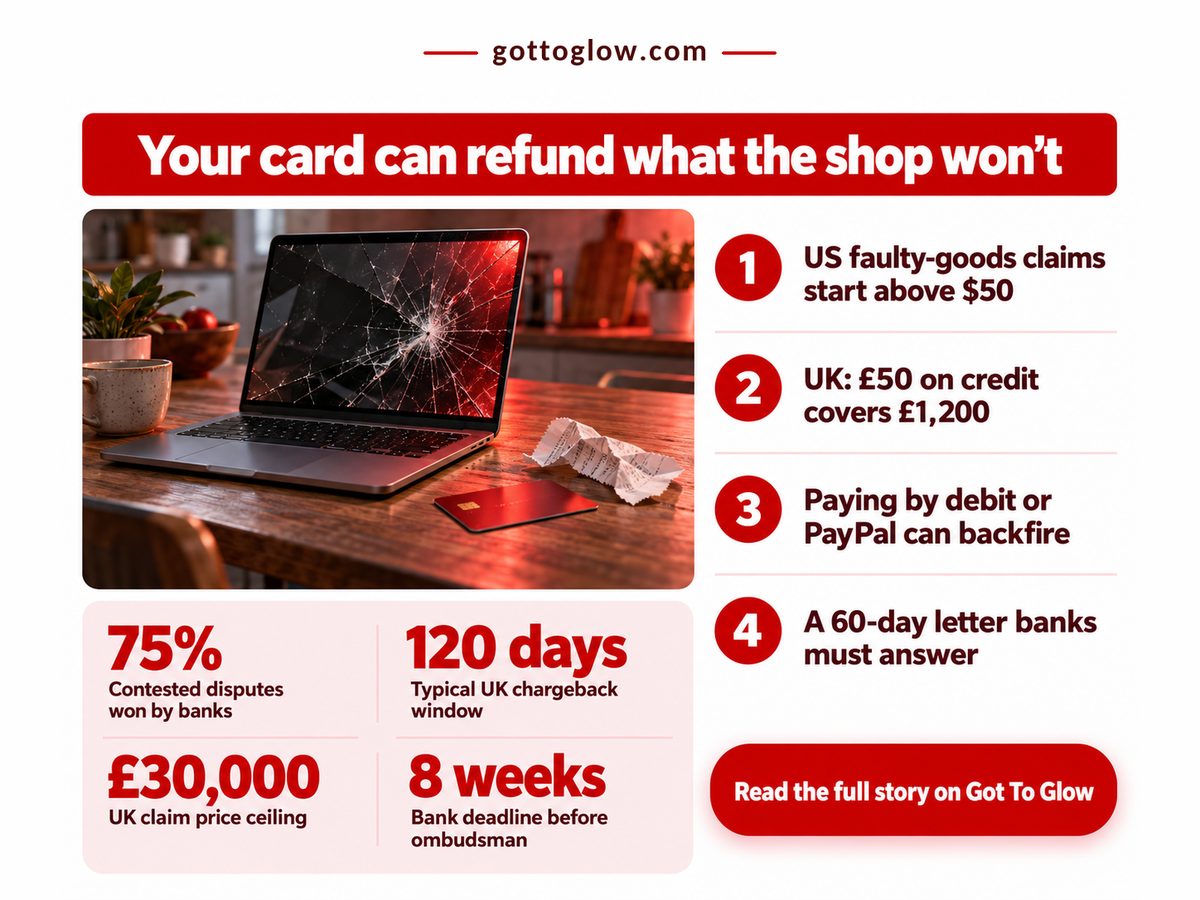
My rule with a dead gadget: settle the money first, the machine second.
Key Takeaways: yes, if a credit card paid for the faulty gadget, the card company can be made to refund it after the seller refuses, if you act in time and keep proof.
- US: the Fair Credit Billing Act lets you withhold payment for a faulty item, within price and distance limits.
- UK: Section 75 makes the lender jointly liable, even if only a deposit went on the card.
- Debit gets you a chargeback at best, at the bank's discretion.
Can I do a chargeback if the seller refuses a refund?
Yes, a refusal from the seller is usually the trigger for a card claim rather than the end of it, because US and UK law both let the card company stand in for a shop that won't pay.
In the US the route is the Fair Credit Billing Act. Its quality-claim section, 15 USC 1666i, lets you hold back the disputed amount on a credit card after a good-faith attempt to settle with the seller. The catch is price and distance, and both bite on a gadget ordered online from another state, unless the store issued the card. The FTC's guidance (as of 2024) is plain that debit cards get fraud protection, not faulty-goods rights. So anything costly goes on credit.
That is the payment-side sequel to who pays when a device fails after the maker's warranty and what bricked smart-device owners can claim from maker versus seller. Those settle who owes you. This is how you collect.
Britain goes further. Under Section 75, paying any part of the price by credit card, even a deposit, makes the lender jointly liable for all of it, says the Financial Ombudsman Service. A £50 deposit on a £1,200 laptop puts the full £1,200 on the card company. By my arithmetic that is £24 of protection per pound charged, and almost nobody uses it on purpose.
Four numbers decide whether a claim is worth starting: the FTC's US letter deadline, the ombudsman's UK ceiling, and two figures from Mastercard's 2025 State of Chargebacks survey of issuers and merchants, as summarised by Chargeback Gurus in June 2025.
US Dispute Letter Deadline
60 days
Miss it, lose the right
UK Section 75 Ceiling
£30,000
Covers any laptop or phone
Card Disputes in 2025
261 million
Banks triage before reading
Disputes Suspected as Abuse
13% to 21%
Why proof beats a story
The letter deadline is where people lose. It belongs to the billing-error route for goods not delivered as agreed, and its clock starts at the first statement showing the charge, not when the laptop died. Keep a dated copy; the issuer must then answer within fixed limits.
Banks sort millions of disputes, plenty of them dishonest. Dated photos and a written refusal lift yours out of that pile.
Chargeback rights in the US and UK, side by side
The UK protects a credit-card buyer more fully than the US does, because Section 75 has no distance test and covers part-payments, while the US quality claim carries price and location limits that many online purchases trip.
Read the left column first: rows run from qualifying to where you're exposed. US rows rest on 15 USC 1666i and FTC guidance; UK rows on the Financial Ombudsman Service.
| Dimension | US vs UK | What it means for you |
|---|---|---|
| 💰 Price floor | US Purchase over $50 UK Cash price over £100 |
⚠️ Cheap accessories rely on chargeback |
| 🌍 Where bought | US Home state or within 100 miles UK No distance test |
❌ Out-of-state online buys can miss out |
| ⏱ Time limits | US Reply in 30, resolve in 90 days UK Chargeback about 120 days |
⚠️ Act early, the clocks never pause |
| 🔒 Debit card | US Fraud cover only UK Chargeback, no Section 75 |
❌ You can only ask, not claim |
| ⚖️ Leverage | US Withhold the disputed sum UK Ombudsman after 8 weeks |
✅ Free pressure, no lawyer needed |
| 🏁 Best suited for | US Credit buys near home UK Any credit buy, even part-paid |
🏁 Put costly kit on a credit card |
In Britain, a credit card turns almost any gadget above the floor into a legal claim. In America, it depends on where the seller sits, unless a store card strips those limits away.
When a seller fights your dispute, the issuer usually comes out ahead, so a refusal is no reason to drop a documented claim. Source: Mastercard's 2025 survey via Chargeback Gurus; the other slice is our remainder.
How long do I have to file a chargeback, and what sinks a claim?
Deadlines run from different dates: UK chargebacks count from delivery of the faulty item, US dispute letters from the first statement showing the charge, and neither from the day the device broke.
The chargeback is weaker than it looks. In the UK it is card-scheme practice, not law, and the ombudsman says your bank doesn't have to raise one. So I'd skip the usual advice to just call your bank: ask for a Section 75 claim by name, and keep chargeback as the fallback.
Does Section 75 cover purchases made through PayPal?
Often not cleanly. Section 75 needs a direct link between you, the lender and the seller, and the ombudsman says that link "isn't always straightforward" when a wallet sits in between. Chargeback is then your likelier route, and pay-later plans open a similar gap, covered in our guide to Buy Now Pay Later refunds on financed devices.
If the bank says no, complain formally. Once its deadline in the table passes, or it sends a final response, the ombudsman can order a refund plus interest, free. Lawyer Monthly's November 2025 guide notes a six-month limit from that final letter.
Watch for:
- A goodwill offer framed as final. Refuse it in writing if it falls short.
- Returning the device before photographing the fault.
- Seller emails that stall while your deadlines expire.
Before you file, check your own purchase
- Some or all of the price went on a credit card.
- The seller took payment directly, not through a wallet.
- You hold a written refusal and dated photos of the fault.
- In the US, the seller is local or issued the card.
Settle the money, then the machine. This week, send your card issuer a dated written dispute with the refusal and photos attached, naming Section 75 if you're in the UK. As for the laptop: replace it, don't repair it. A device that fails early and a seller that won't back it have told you what they're worth.
No comments
Post a Comment