October 22, 2026
Right to Repair After Warranty: A 7-Year Rule
The battery went first, then the trackpad stopped clicking: a 2022 laptop, out of warranty, and a repair quote close to the price of a new one. Keep, repair or replace? Under right to repair after warranty rules, the answer turns on your address and the month the model left the factory, not on the fault. California and Oregon make the maker sell you parts. Most states don't.
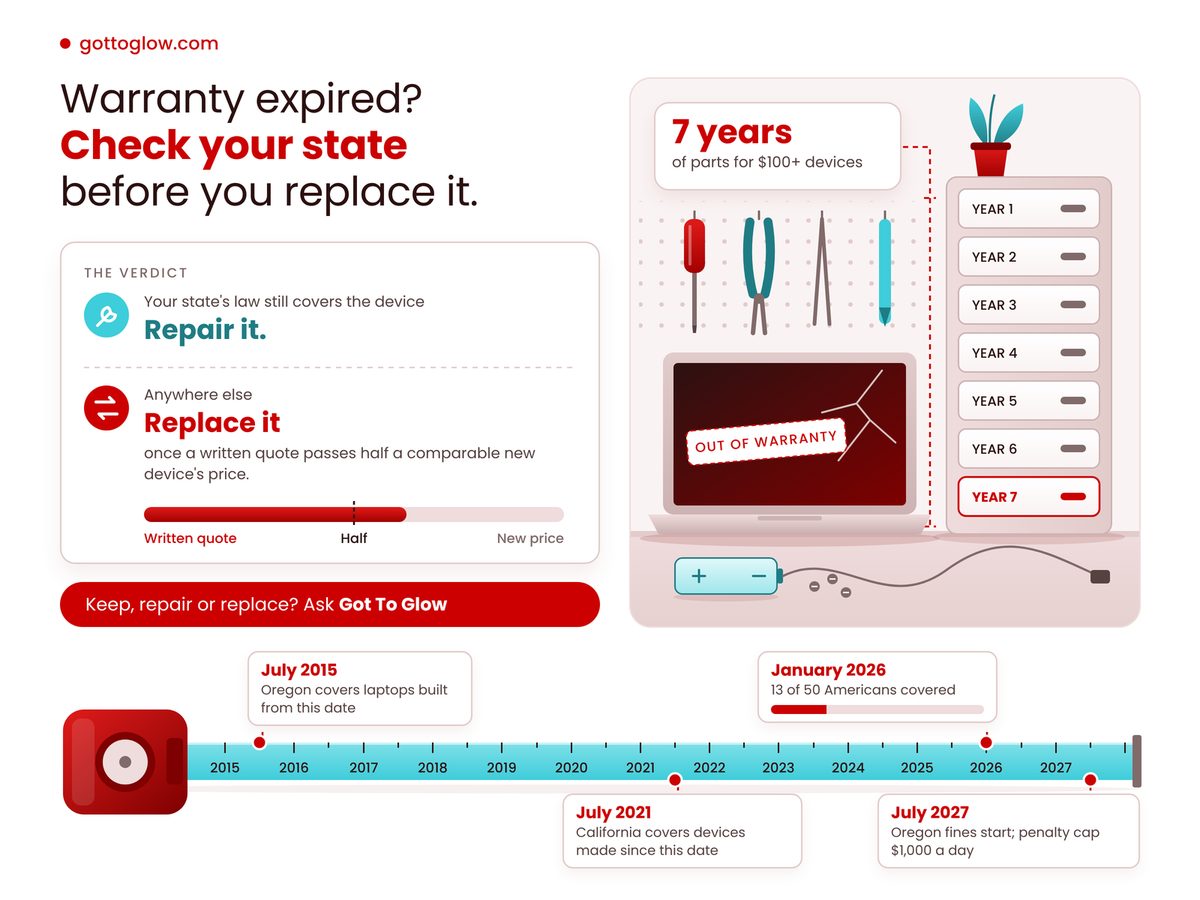
Key Takeaways: repair if your state's law still covers the device; otherwise weigh the quote against a replacement.
- California owes parts for 3 or 7 years after a model's last production run, warranty or not, on devices made since July 2021.
- Oregon covers laptops built from July 2015, but its fines start only in July 2027.
- No state law? Replace once the quote passes half a comparable new device's price (our rule).
Does right to repair after warranty cover your device?
It covers your device only when your state has a repair law and the device falls inside that law's dates and categories; the expiry of the maker's warranty changes nothing about the claim. If some guarantee might still apply, read who pays for a month-14 device failure first; a server shutdown is a different claim: who owes you a refund for a bricked smart device.
How long does a maker have to sell parts in California?
Seven years for any product with a wholesale cost of $100 or more, and three years from $50 to $99.99, counted from the model's last manufacturing date rather than the day you bought it. That is the reading in the state Bureau of Household Goods and Services' June 2024 SB 244 industry advisory, which applies the term "even if the 7-year period exceeds the warranty period."
The law took effect on 1 July 2024 but reaches products made, and sold or used in California, from 1 July 2021, so a 2020 laptop gets nothing and a 2022 one does. Parts must cost you no more than the "most favorable costs and terms" authorized shops get; a higher quote is a complaint, not a reason to replace.
Is parts pairing illegal in Oregon?
Yes, for devices first made and first sold or used in Oregon after 1 January 2025, a maker may not use parts pairing to block or degrade a working replacement part, even one it never approved. Parts pairing is software that locks a component to one serial-numbered device. Its reach, under Oregon Laws 2024, chapter 69, is wider: equipment sold or in use in Oregon from 2025, excluding only phones first sold before July 2021 and other electronics before July 2015.
Four numbers decide whether a claim is worth it. Two come from the statutes above, one is our count between the two cutoffs, and the multiple is California's fine scale as Wiley Rein's May 2024 state-law alert reports it: $1,000 a day at first, $5,000 by a third violation.
Parts Term, $100+ Devices
7 years
Outlasts any one-year maker warranty
Oregon Daily Penalty Cap
$1,000
Enforceable only from July 2027
Laptop Years Only Oregon Covers
6 model years
Derived: July 2015 to July 2021
California Fine, Third Violation
5x the first
Derived: repeat refusals cost makers more
The model-year gap matters if you own an older Windows laptop or MacBook: no claim in California, a valid one in Oregon, since both laws count a device in use there.
In California the warranty is the short clock. The parts clock starts when the model stops being made, and for most phones and laptops it runs seven years.
Right to repair laws by state: who owes you parts
As of October 2026, California and Oregon give out-of-warranty owners the strongest parts claims, New York, Minnesota, Colorado and Washington add their own versions, and most Americans still live where no state law applies.
| Where you live | The parts rule | What it changes |
|---|---|---|
| ⏱ California | Made and sold from 7/2021, $50+ wholesale | Parts owed long after the warranty |
| ⏱ Oregon | Laptops from 7/2015, phones from 7/2021 | Older laptops California skips |
| 🔋 New York | Batteries may come as whole assemblies | A fix can cost a top case |
| ⚖️ MN, CO, WA | MN from 7/2024; CO and WA from 1/2026 | Read the exclusion list first |
| 🌍 No state law | No parts duty, as of 10/2026 | Maker alone sets the price |
California gives a term you can count; Oregon gives wider reach but, for now, no penalty.
Worked example: a laptop bought in California in June 2022 for about $900, with a 12-month warranty, from a model last built in March 2024. Assumptions: made and sold after July 2021, and $900 retail clears $100 wholesale (our inference; makers don't publish it). Seven years from March 2024 is March 2031. The warranty ended in June 2023, so the parts duty runs 93 months past it. Your turn, in under a minute: last production month (or the successor's launch month) plus seven years, against today. A future date means parts are still owed: that is the sum to remember.
Most Americans still live where no state law makes a maker sell parts, so for roughly two in three readers the maker sets the repair price. Source: U.S. PIRG, 26 December 2025: 25.75% covered from 1 January 2026, at least 35.5% after Connecticut and Texas; one icon is one in 50.
Where does a parts claim break down?
A parts claim breaks down at the law's edges, usually because the device was built before the cutoff or sits in an excluded category, and in Oregon because no fine can be imposed until mid-2027. Wiley Rein reports that New York's law, live since 28 December 2023, lets makers sell integrated batteries pre-assembled with other parts for safety. A battery swap can then cost a whole top case, often enough to tip an older laptop to replace.
Oregon is where we part company with the cheerful coverage. Its pairing ban only bites on violations from 1 July 2027, 30 months after the law took effect by our count, so we would not plan a repair around early compliance. If a maker takes payment and never ships the part, use chargeback rights when the seller says no.
- California excludes video game consoles and alarm systems, whatever they cost.
- Oregon still lets a maker limit a paired battery after a thermal event.
- Keep the receipt showing where and when the device was first sold.
Check before replacing:
- Last production month plus the term lands after today.
- The device was first sold or used in a covered state after its cutoff.
- The maker's parts price matches what its authorized shops pay.
Our call: inside California's or Oregon's dates, repair, because the law puts parts and price on the maker. Anywhere else, get a written quote and replace once it passes half the price of a comparable new device; keep it only if the fault is cosmetic. That rule is wrong if the device holds data you have not backed up, so recover that first. This week, find your model's last manufacturing date and run the seven-year sum.
How we checked this
We read the California BHGS SB 244 industry advisory (15 June 2024) and Oregon Laws 2024, chapter 69 (SB 1596, signed 27 March 2024), and took other states' dates as reported by U.S. PIRG (26 December 2025) and Wiley Rein (30 May 2024). The worked example assumes a $900 laptop bought in June 2022, a 12-month warranty and a March 2024 end of production. No product was tested hands-on for this article. Last verified: 22 October 2026.
Edited by G Ragu, reviewed after publication. Spotted something out of date? Tell us and we will correct it.
No comments
Post a Comment