September 08, 2026
EU Legal Guarantee Notice: What It Gets You
Your two year old washing machine stops draining. You dig out the receipt, and the retailer tells you the manufacturer's warranty ran out last month, so there is nothing they can do. That answer has always been wrong inside the EU. From 27 September 2026 it also gets harder to give, because the EU legal guarantee notice has to sit on the product page you bought from, in colour, before you click pay.
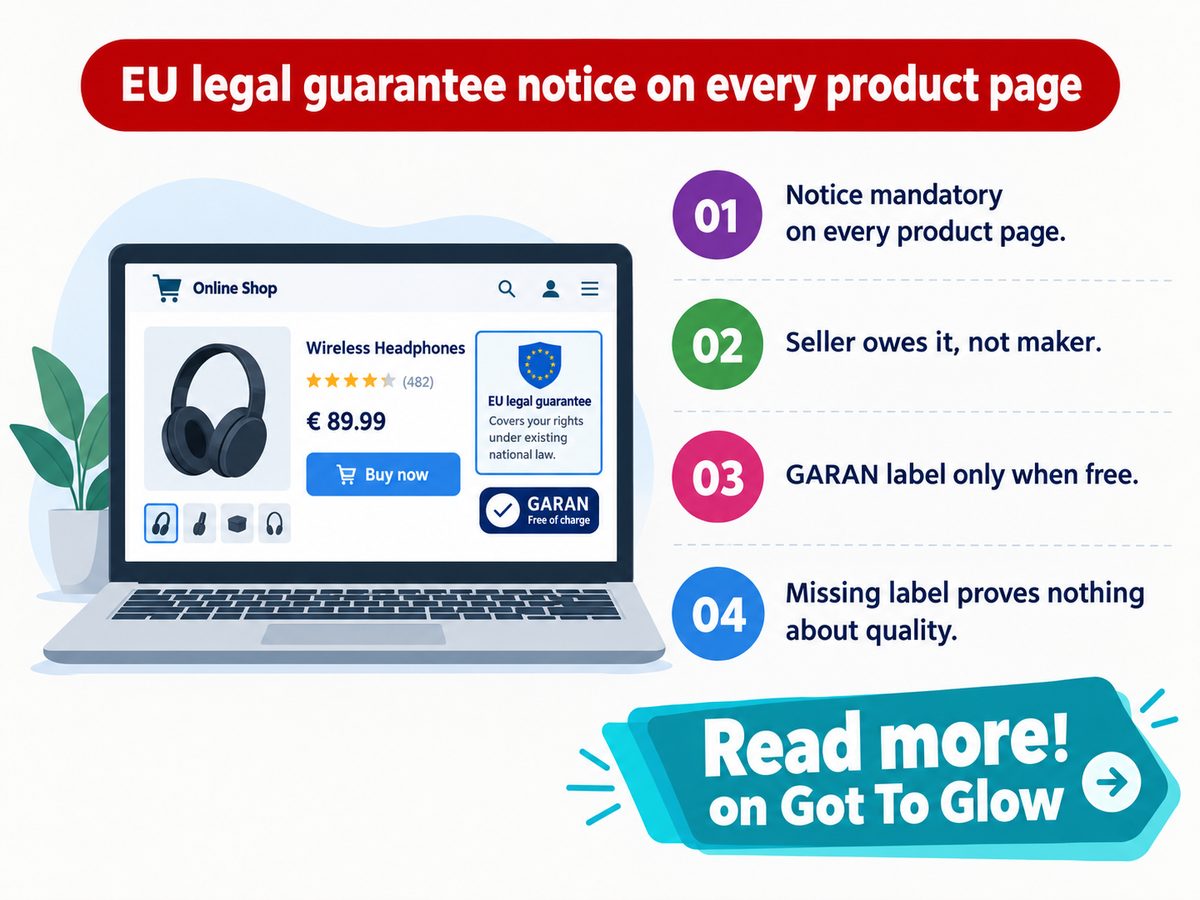
This is a disclosure rule, not a new right: it publicises cover EU shoppers have held for years and mostly never used.
- Commission Implementing Regulation (EU) 2025/1960 applies from 27 September 2026, everywhere at once.
- The GARAN label appears only where a producer's durability guarantee is free, covers the whole product and outlasts the statutory floor.
- Its absence proves nothing about quality, because issuing one is voluntary.
- Chase the seller, not the maker. The legal guarantee is the seller's debt.
Why the EU legal guarantee notice matters now
The notice matters because the right it describes was already law and almost nobody used it, and a rule that forces the wording onto the product page removes the retailer's most reliable excuse.
The underlying cover is old news. Anyone buying goods in the EU gets a minimum of two years of protection from the seller, counted from the day the goods arrive, and that has been settled law for years. What was missing was any duty to say so at the moment it would change a decision. Commission Implementing Regulation (EU) 2025/1960, adopted on 25 September 2025, fixes the wording and the artwork. Directive (EU) 2024/825, the Empowering Consumers directive, supplies the legal hook, and Article 22a of the Consumer Rights Directive is where the display duty actually lands.
The interesting part is who this disciplines. Not the manufacturer. The legal guarantee is owed by the shop that took your money, so putting the notice on that shop's own product page strips out the "contact the manufacturer" deflection that has done most of the damage. We have seen the same shape before, in the way UK statutory cover beat provider policy on Buy Now Pay Later refunds, and again in the state by state cancellation patchwork that replaced the federal click to cancel rule. The cover existed. The disclosure did not. The gap between the two is where shoppers lost money.
And there is real money in that gap. The European Consumer Centre in Spain, run under the Ministerio de Consumo, reported recovering roughly 700,000 euros for consumers across its 2025 caseload, almost all of it on rights those consumers already held before they complained. Read the four figures below as what this rule is worth in practice, not as a summary of what it says.
Extra cover for choosing repair
12 months
Added to the statutory clock
What a GARAN guarantee may charge
€0
Charged means no label
Consumer requests, one country
16,000+
ECC Spain caseload, 2025
Spain's floor over the EU minimum
50%
Three years against two
The repair extension is the one worth planning around. Pick a repair rather than a replacement while you are still inside the statutory window, and the clock restarts far enough that a second failure of the same part still lands inside cover. Retailers push replacement because it closes the file and ends their exposure. Convenient for them. It can quietly cost you the extension.
Seven hundred thousand euros clawed back in one country, in one year, on rights shoppers already had. The notice is not new law. It is an admission that the old law was invisible.
What is the legal difference between warranty and guarantee?
A warranty is a promise a company chooses to make and writes the terms of itself. A guarantee, in EU law, is the cover the seller owes you whether or not anybody promises anything at all.
That distinction is exactly what the two new on-page items are meant to separate. One is a notice about a right. The other is a label about a product claim. Confusing them is how shoppers get talked into paying for protection they already have, so it is worth seeing the two side by side before the notice starts appearing.
| Dimension | Legal guarantee of conformity | Commercial guarantee (GARAN label) |
|---|---|---|
| Duration | Statutory warranty runs from the day the goods are delivered | Must outlast the statutory floor or it cannot be labelled |
| Who owes it | The seller that took your payment | The producer that issued the guarantee |
| Price | Included in what you already paid | Cannot be charged for separately |
| Scope | Goods, digital content, and services paid for with personal data | The entire good, never a single component |
| Proof | Seller must disprove a fault during the first year | Whatever the producer's written statement sets out |
| Remedy | Free repair or replacement before any price cut or refund | Only what the guarantee statement promises |
| Optional | Mandatory across all 27 member states on one date | Voluntary commercial guarantee of durability, so absence proves nothing |
| On the page | Harmonised notice, no smaller than A4 when printed | Label at 95 by 100 mm minimum when printed |
| Best suited for | Anything that fails when it should not have | Comparing two products before you buy |
Read down the first column and the practical rule falls out on its own: the legal guarantee is the one you can rely on without reading anything, and the labelled one is the tie breaker between two products that both already carry it. Neither replaces the other, and a seller who implies otherwise is selling you something.
Four dated 2026 obligations, from Directive (EU) 2024/825, Commission Implementing Regulation (EU) 2025/1960 and the European Consumer Centre Spain's 2026 summary of new consumer rights.
Is a guarantee legally binding, and where does it fall short?
Yes, both kinds bind, but they bind different people in different ways, and the gaps that will annoy shoppers most sit in enforcement and in what this new notice deliberately leaves out of scope.
Line up the four 2026 dates and something becomes obvious that none of the source documents says outright. Transposition in March, an easy cancel button in June, a repair duty in July, the guarantee notice in September. Four separate consumer obligations landing inside a single six month window, which is the fastest run of retail-facing rule changes the EU has shipped in years. That pace is the story, and it is also the reason compliance will be uneven for months after each date.
Scope is the other soft spot. The notice is about goods, so it says nothing useful when the thing that failed was a service, an app, or an automated purchase you did not personally make. That last category is growing fast, and the question of who pays when an AI shopping agent buys the wrong thing sits well outside anything a guarantee notice can answer. The same is true for connected home devices that stop working when a cloud service is withdrawn, where the hardware is fine and the failure is somewhere else entirely.
- A missing GARAN label tells you nothing about build quality. Producers opt in, and plenty of durable products will never carry one.
- Second hand goods can be cut to a one year floor, but only where the seller discloses that clearly before you pay.
- Enforcement runs through injunctions brought by competitors and qualified consumer organisations, not through a hotline that fixes your washing machine this week.
- A trader outside the EU selling into it is still a distance seller. Marketplaces are in scope, which is precisely where compliance will slip first.
Three things worth doing the week the notice appears
Scan the QR code. It resolves to guarantee information in your own language, not the seller's.
Keep the durable statement. Producers must send the guarantee terms on paper or by email by the time the goods arrive.
Screenshot the product page. The notice is evidence of what you were told at the moment you paid.
Do one thing this week. Open the last expensive thing you bought online, find the seller's returns and guarantee page, and check whether it still points you at the manufacturer. If it does, that page has three weeks left to be correct, and knowing it is wrong is what turns a shrug at the service desk into a claim the seller has to answer.
Related: statutory warranty rights when a laptop fails at month 14
No comments
Post a Comment